





How growing brands are rethinking their relationship with customers, and what we learned from getting people to open the Mostaza app even when they weren't hungry.
Think about the last time you downloaded a brand's app to place an order. You opened it, browsed, chose what you wanted, paid, and closed it. Chances are, you didn't open it again until the next time you needed something. By then, your phone may have even flagged it as an app you could delete to free up some storage.
For many businesses, that's the entire customer journey their digital product is designed for: a well-designed storefront.
The problem is that getting people through that storefront is becoming increasingly expensive. Customer acquisition costs have risen by nearly 60% over the past five years across digital industries, and acquiring a new customer can cost anywhere from five to 25 times more than retaining an existing one. On the other hand, someone who has already chosen your brand is 50% more likely to try another one of your products or services.
That's why more and more companies come to us with the same question: how do we get our customers to stick around?
The short answer is that loyalty is built in the moments between one purchase and the next. If you want to understand why, the longer answer is what this article is all about.
Points Aren't Enough Anymore
For years, loyalty meant collecting points: you buy something, earn points, and eventually trade them in for a blender, a discount, or some other reward that ends up gathering dust on a shelf. It's an easy model to understand, but the payoff takes too long, and it's rarely clear what a point is actually worth. Eventually, collecting them becomes boring or simply doesn't feel worthwhile.
In Argentina, that shift is already underway. Mercado Libre, for example, phased out Mercado Puntos in favor of a subscription model, while Banco Galicia moved away from its Quiero! program to focus on cashback. According to VML's Loyalty Pulse study, 95% of Argentinians are familiar with at least one loyalty program, but only 57% actually participate. Meanwhile, 58% compare prices and promotions before making a purchase. What they value most is ease of use and the ability to access a program through an app. Aspirational rewards, on the other hand, rank near the bottom.
Argentinian consumers are loyal to the deal of the day. They have several everyday apps on their phones and will use whichever one offers the best deal on any given Tuesday at the supermarket. In that context, loyalty goes to the app that gives people a good reason to open it today.
The brands that have figured this out have changed the question. Instead of asking how much to reward each purchase, they're asking what customers do when they're not buying anything.
Duolingo is perhaps the clearest example: its system rewards users for showing up every day through streaks, weekly leagues, and missions. Delta, YPF, and Nubank, each in their own way, have expanded beyond their core product by adding services that keep them present in more moments of their customers' lives.
Their apps have gone from being sales channels to becoming places where the relationship itself lives.
Mostaza: Giving People a Reason to Come Back
The Mostaza app worked well, but only when it came to ordering: browse, choose, pay, done. Unless you were hungry or heading to a restaurant, it wasn't exactly your first choice.
The challenge seemed technical, but at its core, it was emotional: how do you get someone to want to open the app even when they're not hungry?
The World Cup was the perfect opportunity. The cultural excitement was already there. The question was how to bring that energy into the app and turn it into something more than a temporary banner.
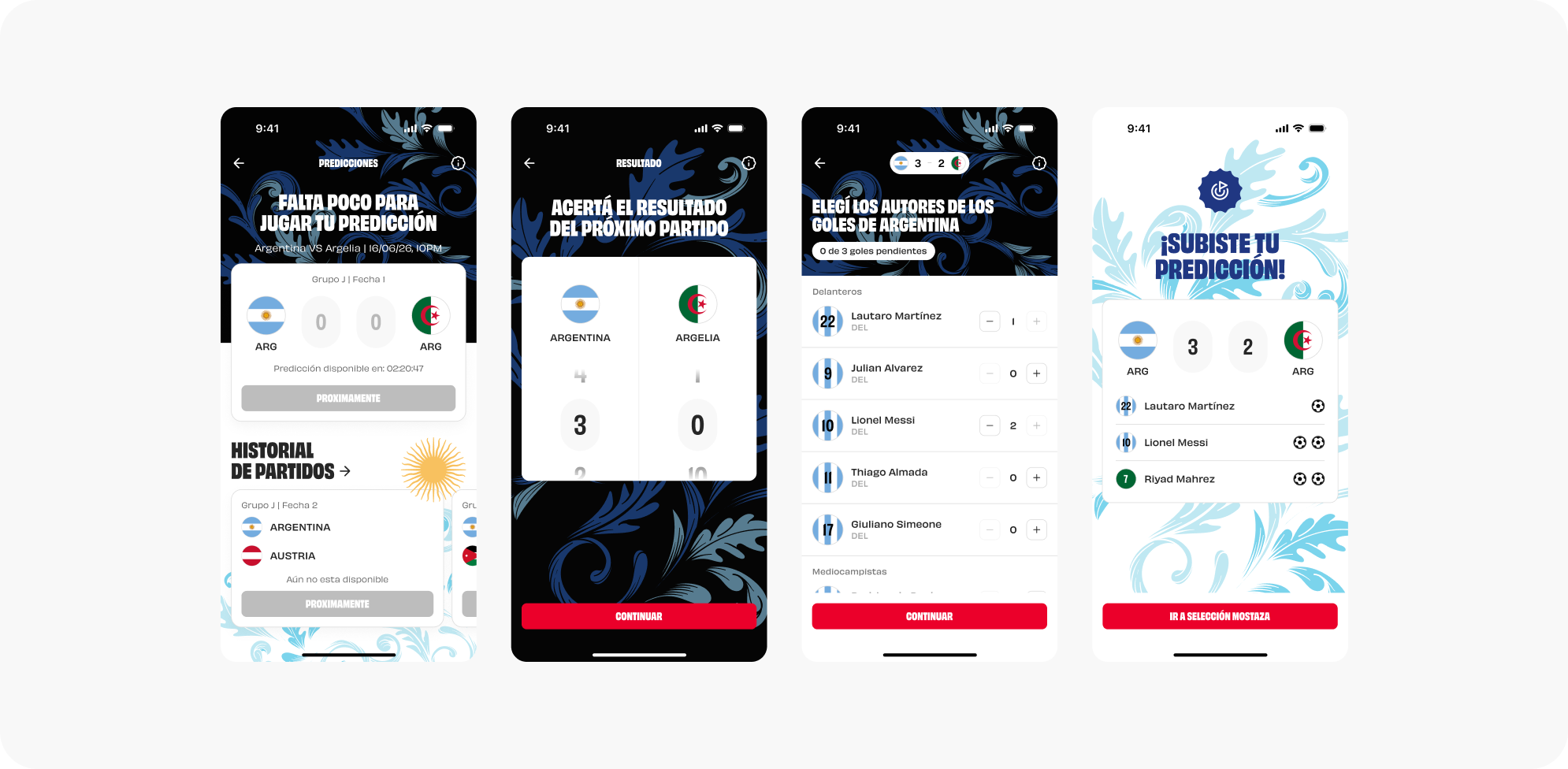
In just eight weeks, we partnered with Mostaza to build a World Cup entertainment hub for users in Argentina, Uruguay, and Paraguay. It featured three interactive experiences designed to work independently and as part of a larger system:
- The Prize Wheel: For those moments when you feel like treating yourself to a little something extra. Each spin offered eight possible rewards, with probabilities calibrated to support specific business goals.
- Match Predictions: A World Cup classic. Before each game, users received a push notification letting them know predictions were open, giving them a reason to check the app, sometimes three days before they'd even thought about ordering a burger.
- The Face-Off with Dibu: A trivia challenge for serious football fans, deliberately designed to be tough. Of the 45,000 people who played, only 9,000 managed to beat him. The challenge had to feel real to make the victory worthwhile.
The real magic was in how these experiences connected. Most prize wheel spins were earned through purchases, but users could also unlock them by answering trivia questions or making accurate match predictions. Playing gave people more reasons to buy, and buying gave them more reasons to come back and play. Entertainment and business were connected through a single loop.
The numbers started telling the story on their own. In the first two weeks, the hub attracted 71,773 active users, with a 184% increase between week one and week two. More than half of all users who entered completed at least one experience from start to finish, well above the 20–30% completion rates typically seen in this type of activation. More than 16,500 rewards were distributed, and National Hamburger Day marked the peak, with 30,409 active users in a single day.
Over time, we started seeing the behavior we wanted to create for Mostaza: people coming back to the hub even after using their available spin, without making a purchase in between.
And What Happened After the World Cup? A Monster Happened.
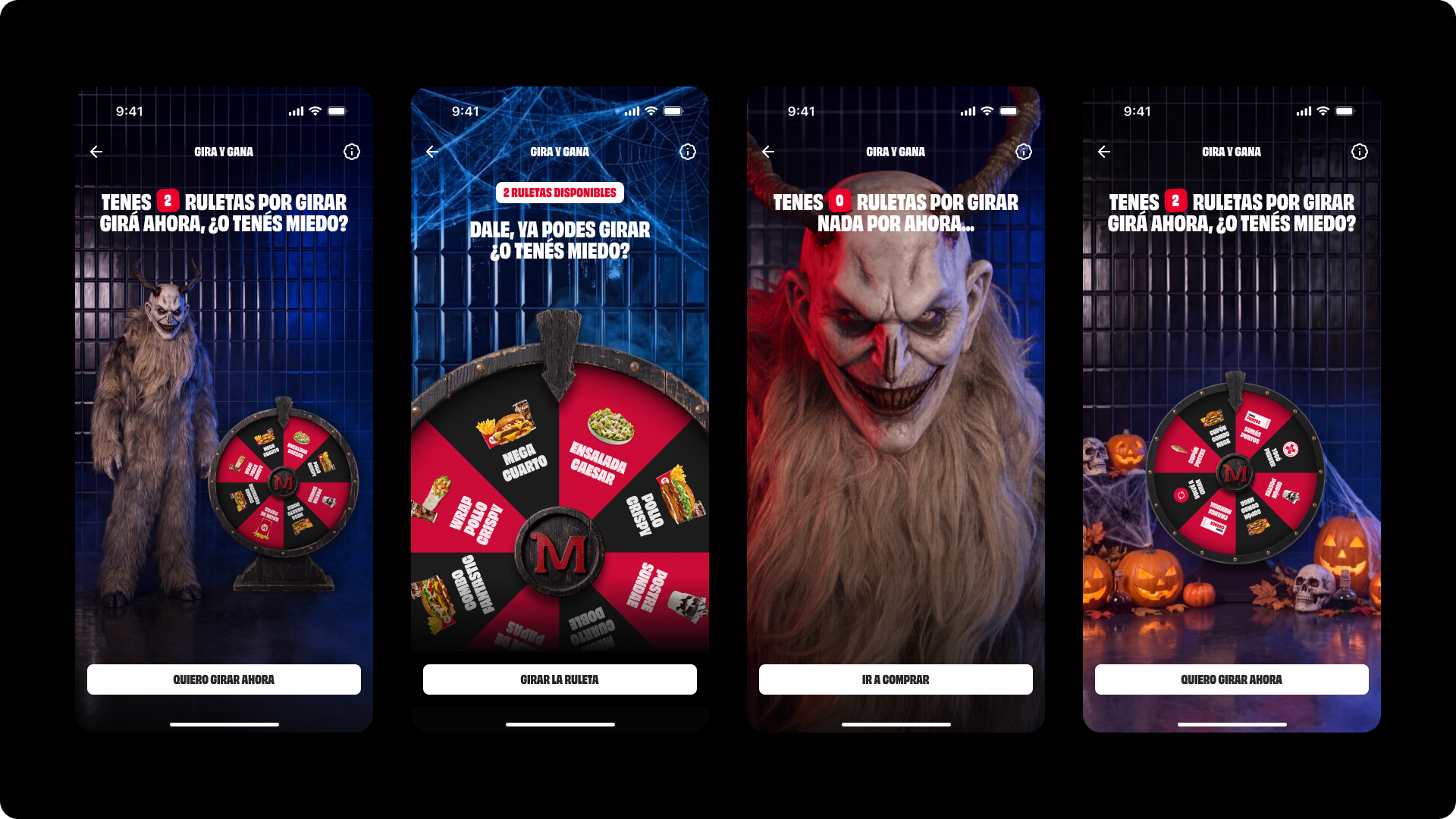
The hub was designed to outlive the tournament, and Halloween put that idea to the test.
This time, the brand brought a monster to life. Users could spin a prize wheel to win rewards while getting the occasional jump scare along the way. Same underlying structure, brand-new story.
And that's where the difference between a one-off activation and a system becomes clear. An activation disappears when the event is over. A system stays in place, ready to be brought back to life whenever a relevant moment comes along, whether it's the World Cup, National Hamburger Day, or Halloween.
What We Learned About Designing for Repeat Engagement
1. Look at what happens between purchases. Around your core product, there are always other things your customers are already doing. For Mostaza, it was sharing the excitement of the World Cup with fellow fans. Finding those moments is one of the simplest ways to expand your value proposition without changing your business.
- . Give every mechanic a purpose. A mission, a reward, or a prize wheel is a business objective disguised as a game. If you want to increase purchase frequency, reward people for coming back. If you want to increase average order value, reward bigger purchases. What you choose to reward is exactly what you're asking users to do.
3. Make gameplay and purchases feed each other. Mostaza's loop works because buying earns spins, while playing creates more reasons to buy. When a mechanic operates in isolation from the business, it generates activity that doesn't necessarily lead anywhere.
4. Keep the next reward within reach. A quick early win, a challenge that feels genuinely difficult, and a reward that matches the effort go much further in sustaining interest than one big prize that's always somewhere in the distant future.
5. Build a system that outlives the campaign. When the underlying structure stays active, every relevant date on the calendar becomes an opportunity to bring it back with a new story, just as we did with Mostaza for Halloween.
6. Start small before investing big. Running quick experiments during the discovery phase is often more valuable than executing a fully polished idea from day one. A good experiment turns an intuition into evidence, and evidence makes it much easier to get the rest of the organization on board.
Repeat Engagement Is Designed
Customers stick around when they find more than one reason to come back to your brand. The more needs you meet for the same person, the harder it becomes for them to leave, and the more natural it feels to choose you next time.
If your app starts and ends at checkout, let's talk and figure out what could give your customers a reason to come back.