











AI Agents: the New Frontier in Automation and Productivity
By Sofia Ferro — Product Engineer at Paisanos
Between the pages of Dune there’s a warning that repeats like a mantra: “Thou shalt not make a machine in the likeness of a human mind.” It’s not a minor line. It belongs to the Orange Catholic Bible, the sacred text Frank Herbert imagined for his universe. For decades, that idea worked as a symbolic boundary between science fiction and reality.
But something changed.
In recent years (pandemic included, digital acceleration in full swing, and the arrival of ChatGPT as a clear inflection point), fiction stopped projecting distant futures. What’s being built today already writes, converses, reasons, and makes decisions alongside us. And it does so in real time.
In that context, artificial intelligence agents stopped being a theoretical concept and became one of the most tangible transformations of work and productivity.

2025: the year AI agents leave the lab
Just a few months ago, in September 2024, Google published a technical paper on the Architecture and Operation of AI Agents. As 2025 begins, it’s already fair to say this will be the year of agents. In the words of Sam Altman himself, CEO of OpenAI, on his blog:
We are now confident we know how to build AGI as we have traditionally understood it. We believe that in 2025, we may see the first AI agents “join the workforce” and materially change the output of companies. We continue to believe that iteratively putting great tools in the hands of people leads to great, widely distributed outcomes.
That statement didn’t stay theoretical. OpenAI recently launched Tasks, a beta feature within ChatGPT that allows autonomous, scheduled actions: from simple reminders to recurring workflows like weekly reports or personalized information routines.
It’s a first step, but it signals something essential: asynchronous operation. Agents no longer wait for a direct command. They plan, execute, and come back with results.
So the question stops being whether they will exist, and becomes something else entirely: what is an AI agent, really, and how does it work?

What is an AI agent (and why it’s not “just” a model)
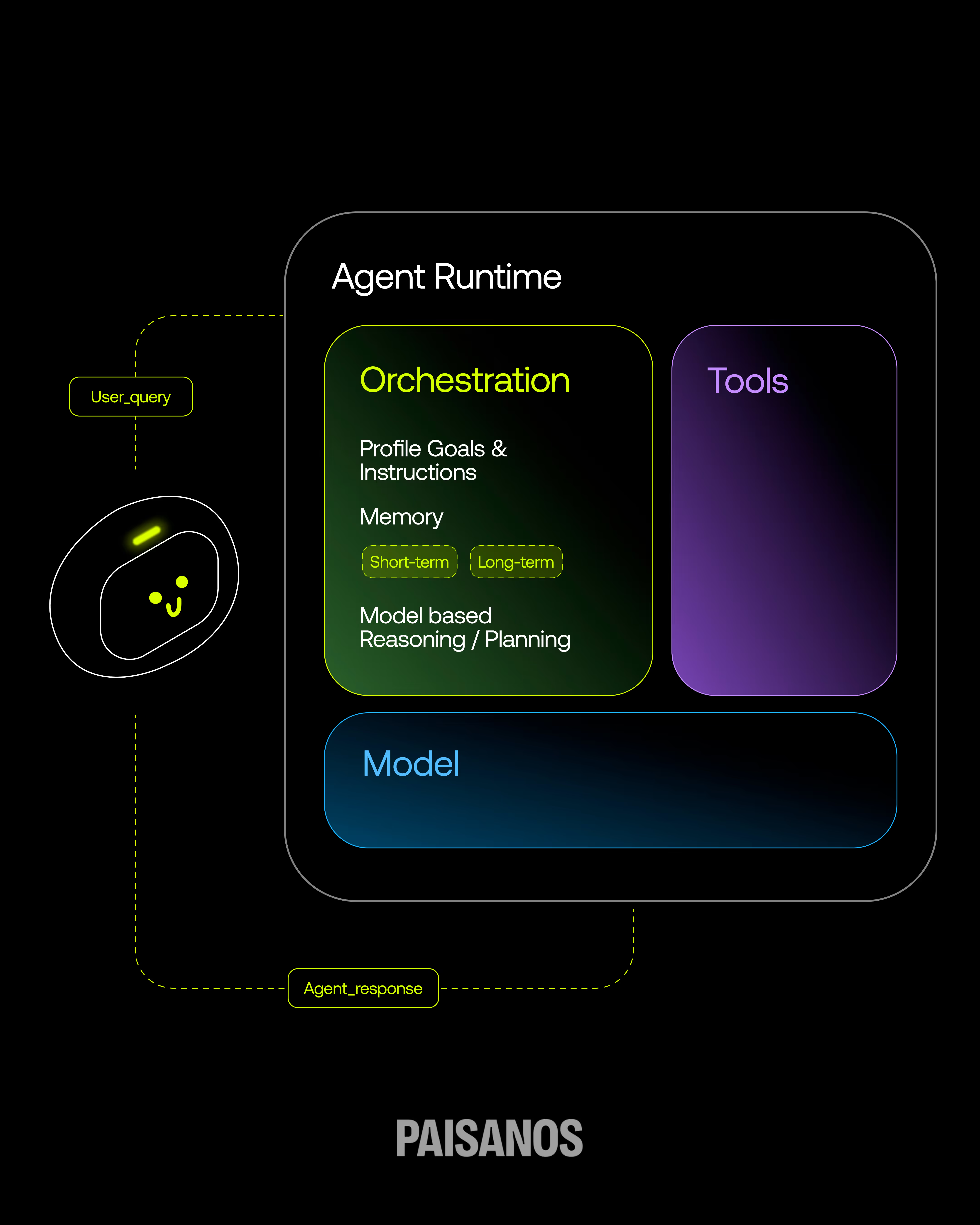
Agents, written by Julia Wiesinger, Patrick Marlow, and Vladimir Vuskovic from Google’s AI dream team, is a technical paper that explains how generative AI agents work. What’s new here? These applications extend the capabilities of language models through the use of tools that allow them to interact with the real world. An agent is, then, a new layer of abstraction whose novelty lies in its cognitive architecture, made up of three components: the language model, the tools (extensions, functions, and data stores), and the orchestration layer.
The model: the decision-making core
The model is the agent’s brain. In most cases, it’s a large language model (LLM), though it can also be a combination of models with different sizes and specializations.
What matters is not only its ability to generate text, but its capacity to reason within logical frameworks. This is where approaches like step-by-step reasoning, decision trees, or reflection loops come into play, mechanisms that allow the model to evaluate options before acting. Depending on the agent’s needs, the model can be general-purpose, multimodal, or fine-tuned for specific tasks.
Tools: the bridge to the real world
Without tools, an agent stays in the realm of discourse. With tools, it can operate.
Tools allow the agent to query databases, execute functions, interact with APIs, or access up-to-date information. In practical terms, they’re what enable an agent to connect systems, read external data, or take action in other digital environments.
In current setups, these tools are typically organized into extensions, specific functions, and data stores, greatly expanding the agent’s operational reach.
The orchestration layer: memory, planning, and control
Orchestration is what keeps everything in motion. It manages the agent’s state, memory, reasoning, and action planning in continuous cycles.
Thanks to this layer, the agent can evaluate whether it has already achieved its goal, adjust its course, or stop when appropriate. This isn’t blind execution, but traceable, auditable, and adjustable processes.
Why agents truly change how we work
Unlike the thinking machines of Dune, AI agents shouldn’t be black boxes. Real-world implementation demands clear processes, constant monitoring, and documented reasoning. Trust doesn’t come from magic, it comes from traceability.
In the workplace, this opens up a wide range of concrete applications. An agent can analyze data in real time, coordinate multiple systems, detect patterns, or execute corrective actions without direct human intervention. From optimizing advertising campaigns to connecting a CRM with financial systems or analyzing customer support interactions, the impact is especially strong in organizations that operate with large volumes of information or require continuous availability.
Rather than replacing tasks, agents free up cognitive time to think better.
%252017.31.52.avif)
How we use AI agents at Paisanos
Together with the QA team, we’re using Autonoma, an AI-powered automated testing tool that leverages natural language to simplify testing, improve team efficiency, and optimize maintenance in agile environments. This allows us to design and execute test cases faster, adapt to the constant changes of agile development, and ensure product quality without compromising delivery timelines. Instead of being limited to repetitive test execution, we now use that time to create and imagine new ways to improve and scale our product.
It’s now: why implementing AI agents is already a strategic decision
AI agents are no longer a future promise. They’re an expanding reality. With frameworks like LangChain and platforms that make secure deployment easier, the barrier to entry keeps getting lower.
The real competitive advantage won’t be in using them first, but in knowing how to implement them with judgment, responsibly, transparently, and aligned with real business objectives.
At Paisanos, we guide organizations along that path. And yes, we also make sure the agents don’t read Dune. Just in case.
Q&A on AI
What is an AI agent?
An AI agent is a system that combines a language model, external tools, and an orchestration layer to reason, plan, and execute actions autonomously in real-world environments.
How is an AI agent different from a chatbot?
Unlike a chatbot, an agent can execute actions, interact with external systems, maintain state, and make goal-oriented decisions, not just respond to messages.
What are AI agents used for in companies?
They’re used to automate complex processes, analyze data in real time, integrate systems, optimize operations, and free up human time for strategic tasks.
Do AI agents replace people?
No. Their greatest value lies in complementing teams, eliminating repetitive tasks, and increasing analytical and execution capacity, not in replacing human judgment.