







By Sofia Ferro — Product Engineer at Paisanos
There’s a question those of us who work in technology ask ourselves every year:
Which programming language is most in demand? What should I learn next? What roadmap should I follow to avoid being left behind?
For a long time, these questions worked as a kind of industry thermometer. But one thing hasn’t changed: a developer with a solid foundation in algorithms, data structures, and best practices can adapt to almost any language without too much trouble.
Still, we won’t dodge the question. We’ll just answer it with a twist: the language of the future is natural language.
And that future has already begun.
When programming starts to feel like a conversation
Let’s imagine a scenario (one that’s becoming less fictional by the day) where machines don’t just understand our language, but can create solutions based on human instructions.
Just as today we write code that turns into applications, in this new paradigm we interact with complex systems simply by talking to them.
This doesn’t mean traditional programming is going to disappear. It means something more interesting: the way we program is changing, and it’s doing so at an unprecedented speed.
Generative artificial intelligence and natural language processing are redefining the interface between humans and technology. We’re no longer just writing code, we’re expressing intent, context, and goals in everyday language.
AI and natural language processing: a conceptual foundation
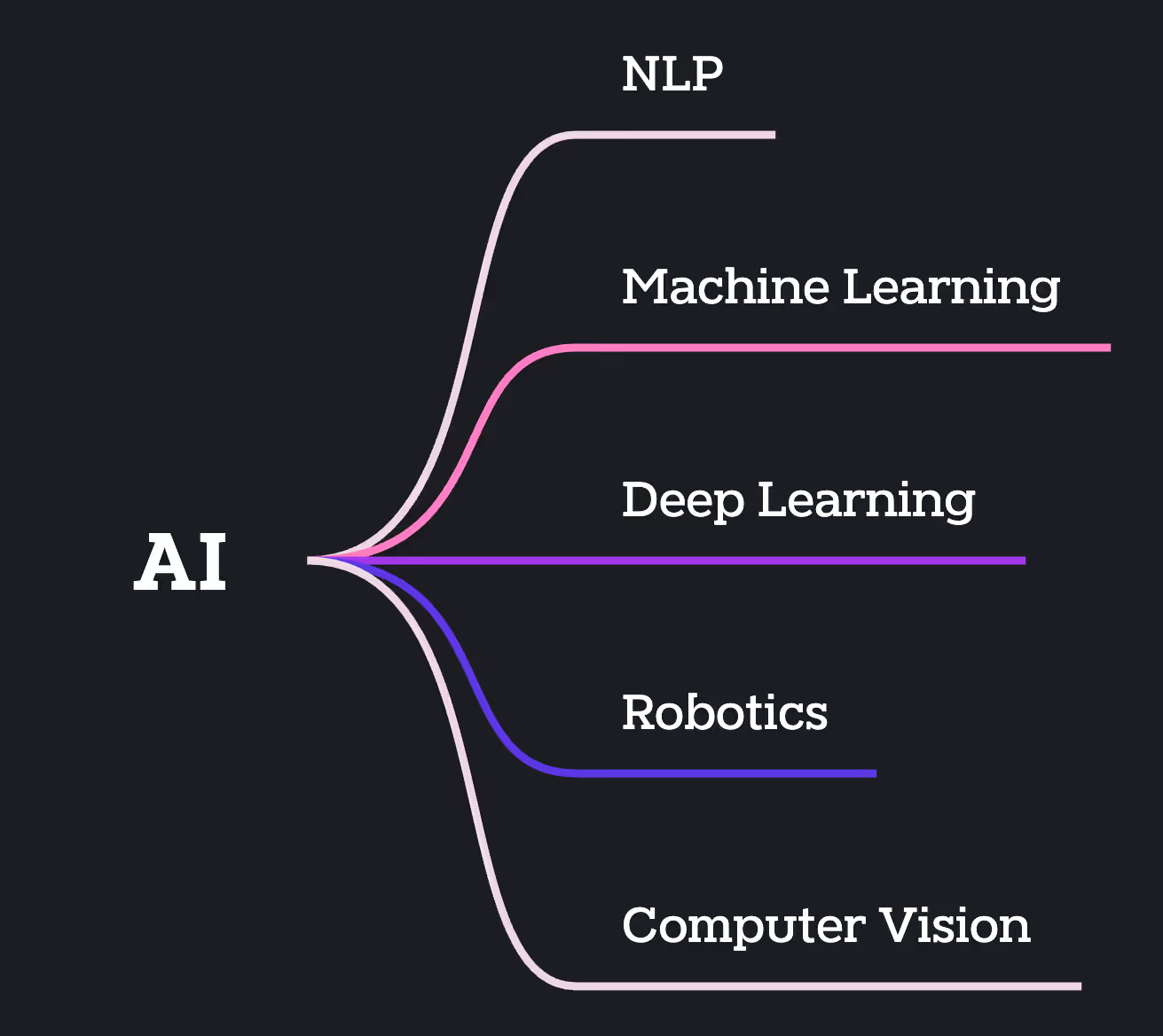
Artificial intelligence focuses on developing systems capable of performing tasks that, until recently, required human intelligence. Within that field, natural language processing (NLP) has a very specific goal: enabling computers to understand, interpret, and generate human language.
Together, these technologies unlock something crucial: systems that understand meaning, not just rigid instructions. And that opens the door to more accessible, efficient, and adaptable experiences, for both users and organizations.
Why this shift matters (a lot) for businesses
Adopting AI and NLP isn’t just a technological decision. It’s a strategic one.
When these technologies are integrated thoughtfully, their impact shows up across multiple layers of the business.
Competitiveness in increasingly demanding markets
Intelligent automation and personalization allow companies to respond faster to market changes and evolving user expectations.
More relevant user experiences
AI-powered chatbots and virtual assistants can provide personalized support 24/7, but the real value emerges when those interactions generate learning: understanding patterns, needs, and real friction points.
Optimization of internal processes
Analyzing large volumes of data, detecting patterns, and making real-time decisions help improve operational efficiency and reduce hidden costs.
Innovation and sustained growth
AI and NLP enable new products, new services, and new ways of approaching complex problems, not as a futuristic promise, but as a concrete competitive advantage.

A possible roadmap to get started with NLP
For those coming from a programming background and looking to move into AI, the path isn’t linear or unique. But there are some fundamentals that serve as a solid base.
First, it’s important to understand the core concepts of natural language processing: how text is represented, how it’s processed, and how models are trained to interpret meaning. Techniques like tokenization, lemmatization, and embeddings translate human language into something machines can work with.
Then comes the programming language. Python has established itself as the standard for AI and NLP, thanks to its ecosystem of libraries like NLTK, spaCy, and scikit-learn. For those coming from JavaScript, there are also compatible alternatives and adaptations.
From there, the focus often shifts to deep learning frameworks. Tools like TensorFlow and PyTorch make it possible to work with more complex models, while libraries like Hugging Face democratize access to pre-trained models. Within this same ecosystem, tools like LangChain or Pinecone simplify the development of applications built on large language models.
But nothing replaces practice. Real projects (text classification, sentiment analysis, language generation) are what truly consolidate learning.
And, as with almost everything, community matters. Sharing experiences, joining hackathons, collaborating with other professionals, and learning together can dramatically speed up the process.
Natural language as the new interface
If we look at the broader historical moment, it’s not an exaggeration to talk about a new technological revolution. Just as the First and Second Industrial Revolutions transformed work and production systems, this transition is redefining how digital solutions are built.
Artificial intelligence systems are beginning to function as a new interface layer between humans and technology, a layer that’s more flexible, more expressive, and paradoxically, more human.
In this context, adopting these technologies isn’t a trend or a race to the latest framework. It’s a way to stay relevant in a world where conversation is becoming just as important as code.
To better understand why natural language is changing how we program
When people talk about AI, NLP, and natural language, a few recurring questions tend to come up. Here are some of the most common ones.
Will natural language replace traditional programming languages?
No. Traditional languages remain fundamental. The change lies in how we interact with systems: natural language is added as a new layer, not as a replacement.
Does this only impact developers?
No. The impact is transversal. CTOs, CEOs, product teams, and business teams also benefit from more accessible, expressive, and adaptable systems.
Do you need to be an AI expert to get started?
No. Understanding the basic concepts and experimenting with existing tools is a great first step. The barrier to entry keeps getting lower.
Does implementing AI and NLP provide a real competitive advantage?
Yes, when it’s done with judgment. It’s not about using AI because it’s trendy, but about solving real problems more efficiently and at scale.