

Anthropic: If You Don’t Push People Away, They’ll Come Back on Their Own
How a product decision (not a commercial) became the most awarded brand strategy of the year, and why the real case study isn’t the spot itself, but what happens when a user asks their very first question.
Anthropic’s Super Bowl campaign didn’t work simply because the commercials were good and original. It worked because when users opened Claude for the first time, the product delivered on what the ads had promised. The intersection between what a brand says (storytelling) and what its product does (story-doing) is the real case study here. And, more often than not, it’s also the most fragile point in the entire journey. So in this insight, we’re going to break it down layer by layer, with the numbers to back it up and the sources behind them, to better understand what actually happened.
First: what were those commercials about? (And why a spot is never “just something attention-grabbing”)
Before we start peeling back the layers of the case, it’s worth looking at the pieces in full, because this is usually where things get misunderstood if the basic principles of advertising aren’t fresh in your mind.
We tend to think of a commercial as something polished, expensive and eye-catching, designed to “make noise,” “grab attention” or “attract new customers.” And sure, it can do all of those things. But a good commercial is really a strategic decision disguised as thirty seconds of entertainment, where every shot can potentially answer a business question.
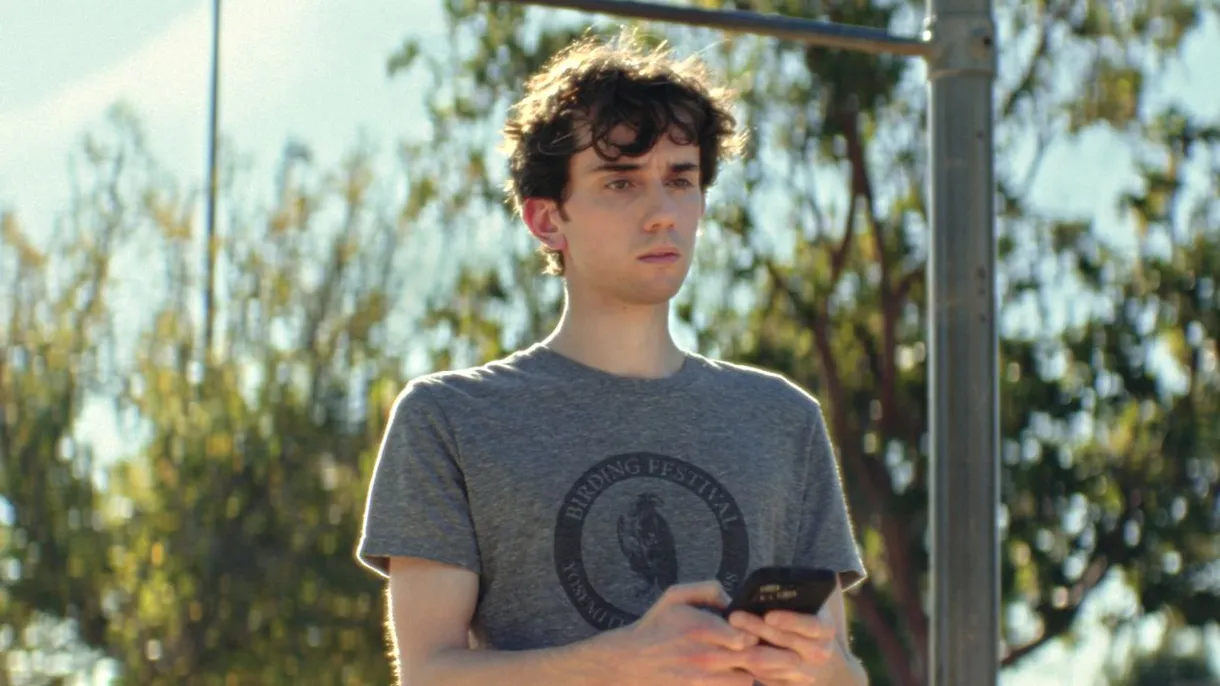
Anthropic’s commercials (its first-ever Super Bowl appearance) were grouped under the title “A Time and a Place,” created by agency Mother London and directed by Jeff Low through Biscuit Filmworks. They’re two dark-comedy spots:
- “Can I get a six pack quickly?”: someone asks an AI an everyday question about getting in shape.
- “How can I communicate better with my mom?”: someone asks a deeply personal, vulnerable question about improving their relationship with their mother.
In both cases, the mechanics are the same: a fictional ad-supported chatbot starts by offering genuinely useful advice, then suddenly derails the answer with a ridiculous, wildly inappropriate sponsored plug, from dating sites to insoles that make you look taller.
It’s not a random joke. It’s an uncomfortable demonstration of what AI could become if advertising were allowed to creep into the conversation itself.
What makes it interesting is why it was built this way. Every creative choice is, ultimately, a positioning decision.
- It sells what it refuses to become, not what it does. Most AI brands compete over who is “smarter” or has the best benchmarks. Anthropic did the opposite: it didn’t show a single Claude feature. It shifted the conversation away from capabilities and toward principles, turning something intangible and difficult to communicate (trust) into the centerpiece of the campaign.
- Show, don’t tell. Instead of simply saying “Claude has no ads” (a claim almost anyone could make) the campaign makes you feel how obscene a world with ads inside AI conversations would be. The audience reaches the conclusion on its own, and a conclusion you arrive at yourself carries more weight than a slogan.
- The questions were chosen deliberately. The more human and vulnerable the question (your relationship with your mother, your body) the more violent the commercial interruption feels. The discomfort does the persuasive work that a statistic never could. It’s the same logic behind connecting with real pain points in the best campaigns: the message lands emotionally before it lands rationally.
- Dark comedy is the vehicle, not the destination. Humor lowers your guard and makes the piece memorable and shareable. Which is why the biggest spike in conversation came through word of mouth, not on game day.
Proof that this was about the idea rather than production spectacle? The Grand Prix it won was in the Film category at Cannes Lions, which rewards the strength of the narrative, direction and storytelling idea, not special effects or technical craftsmanship, which are judged separately under Film Craft.
In other words: it didn’t win because it looked impressive. It won because of what it had to say.
But that’s only the visible half of the story.
A commercial is a promise delivered once, to millions of people at the same time. The other half (the one that determines whether that promise holds up or falls apart) only begins once the viewer turns off the TV, downloads the app and types their first question.
How much did Claude grow after its Super Bowl commercial?
There was a moment when a user opened Claude for the first time and the entire thing could have fallen apart.
Someone could have watched the Super Bowl spot, downloaded Claude, signed up and typed something for the first time. One simple question. And right there, the product could have defaulted to the usual interaction: answer as quickly as possible after a loading screen, no unnecessary waiting around, because if users have to wait and get bored, they leave.
Had they done that, the most awarded campaign of the year would have turned into a thirty-second lie for that user.
Fortunately, that’s not what happened.
And that interaction (not the commercial) is the real case study we want to explore.
The numbers around the ad are already well known, so let’s start there before moving on to what almost nobody looks at.
According to BNP Paribas data cited by CNBC, after Super Bowl LX, Claude’s daily active users grew 11% and traffic to its website increased 6.5%, the biggest jump among any AI company advertising during the game.
For context, ChatGPT saw just a 2.7% increase in active users during the same period, while Gemini grew 1.4%.
That momentum pushed Claude from No. 41 to No. 7 in the U.S. App Store’s free-app rankings (its highest position ever) with downloads growing more than 32% over three days, outperforming Meta, Google Gemini and OpenAI, according to Appfigures data reported by TechCrunch.
The game itself was watched by 125 million people in the United States.
The journey where brand promise and product meet
Every journey has a moment like this, even when it isn’t obvious.
The brand promise lives in the campaign: in the commercial, the script, the oversized logo at the top of the page, the website hero.
The value proposition lives in the product: in the actual experience of using it, in what happens after you watch the commercial and open the app.
For a good part of the journey, those two things operate separately. You watch an ad, download an app, create an account.
It’s only during that first interaction that the two timelines finally meet.
And that intersection is the most fragile moment in the entire journey, because for the first time, the user can compare what they were promised with what they’re actually getting.
It’s the same principle we work with at Paisanos in other cases: communication rooted in the value proposition wins when the product can actually deliver on it.
Otherwise, the message arrives too late, or worse, it arrives and disappoints.
Wow! When the brand promise becomes the value proposition
In UX, the “wow moment” is the first moment when users truly feel the product’s value proposition.
What the product does during that flow is also where the brand promise becomes real.
And for that to happen, three layers need to work together at the same time:
- Verbal language: the copy, voice and tone.
- Visual language: the interface and micro-interactions.
- User experience: CTAs, the funnel and timing.
If the feature takes too long or breaks, the “wow moment” never happens, no matter how thoughtful or beautifully designed everything else is.
With Claude, these three layers operate at the same rhythm, supporting the experience from the moment a need arises all the way through the user’s first interaction with the product.
The wording doesn’t need to distract you with reassuring copy while the software executes commands behind the scenes. The feeling that Claude is actually reasoning is visible before it gives you an answer.
That’s where “Keep Thinking” stops being a marketing line and becomes a wink from the brand inside the product itself.
And there was a very real risk here.
Showing the reasoning process instead of immediately serving up a generic answer adds seconds of waiting time. In almost any product dashboard, those extra seconds show up as “pain.”
A product team looks at that metric and has plenty of reasons to shorten the wait.
Had they done so, they might have solved a product problem while accidentally killing the one signal that proved “Keep Thinking” was actually true.
A quick reality check: not all of the post–Super Bowl growth can be credited to the commercial.
During the same period, Anthropic launched Opus 4.6, while ChatGPT had just started introducing ads to free users (exactly the scenario Anthropic’s commercial was warning about) giving the campaign a level of cultural timing that would be difficult to reproduce.
In fact, downloads didn’t peak on game day. According to Appfigures, the peak came on February 17, more than a week later, driven by word of mouth and press coverage.
In other words: the commercial opened the door, but what made people come back was what they found on the other side.
Which is, once again, the point of this entire article.
The chicken or the egg
Those three layers don’t align by accident.
What makes that intersection possible is someone from the creative team and someone from the product team sitting down to look at the same problem instead of solving it separately.
We come from a world where those two disciplines barely spoke to each other: the agency delivered the script, and whatever happened after the first screen was no longer its problem.
Today, when mass consumption is also digital, that separation no longer makes sense.
The people creating the campaign need to understand what the product feels like. And the people building the product need to be involved in what the campaign is going to promise.
Because both teams are telling the same user story, just from different angles.
This isn’t a minor process detail. It’s what makes it possible for the commercial and the first screen to tell the same story.
The campaign could promise “an AI that doesn’t interrupt you with ads” because someone on the product side had already decided Claude wouldn’t have ads.
When those two teams work with their backs to each other, the script promises something the software can’t sustain.
And that’s exactly where the gap between expectation and experience begins.
Beautiful morning, isn’t it?
That wink doesn’t end after the first “wow moment.”
It continues in one of the smallest and most frequently repeated details: the greeting.
When someone opens Claude at six in the morning and reads “Hello, early bird” instead of “Welcome back,” they’re seeing the same concept behind the entire campaign condensed into a single line.
And it doesn’t stop there. You can also see it in:
- The follow-up questions it suggests after an answer, which are designed to continue your train of thought rather than push you into spending more time in the app.
- The way it tells you when it isn’t sure about something instead of making something up with the same confidence it would use if it knew the answer.
- The absence of retention hooks: no notification pushing you to come back, no streak that breaks if you miss a day, no counter rewarding you just for opening the app when you don’t actually have anything to ask.
- Artifacts: if you generate a document, chart or code, it belongs to you. You can take it with you. The product doesn’t need to keep you trapped inside the conversation to prove it was useful.
It’s a retention ritual, not an activation tactic.
You see a commercial once. You encounter these product behaviors every day.
Anthropic formalizes this in its own positioning, describing Claude as “a space to think”, a place for thinking, without ads.
Getting all of this to coexist is delicate, because brand and product often live in completely different galaxies inside a company, with their own goals and their own bosses, and —if we’re lucky— they get together once a quarter to see how the backlog is going.
That’s exactly where storytelling (what the brand says) can drift away from story-doing, what the product actually does.
And where it’s worth remembering something simple: trust isn’t only something you can earn. It’s also something you can lose.
That’s what happens when the promise isn’t grounded in the reality of the product.
Not running ads is a strategy too, and the numbers prove it
That’s why Anthropic’s decision not to introduce ads inside the product isn’t an aesthetic stance. It’s a business strategy that the campaign simply made public.
And here’s perhaps the most compelling number of all: Anthropic built a massive business before spending a single dollar on advertising.
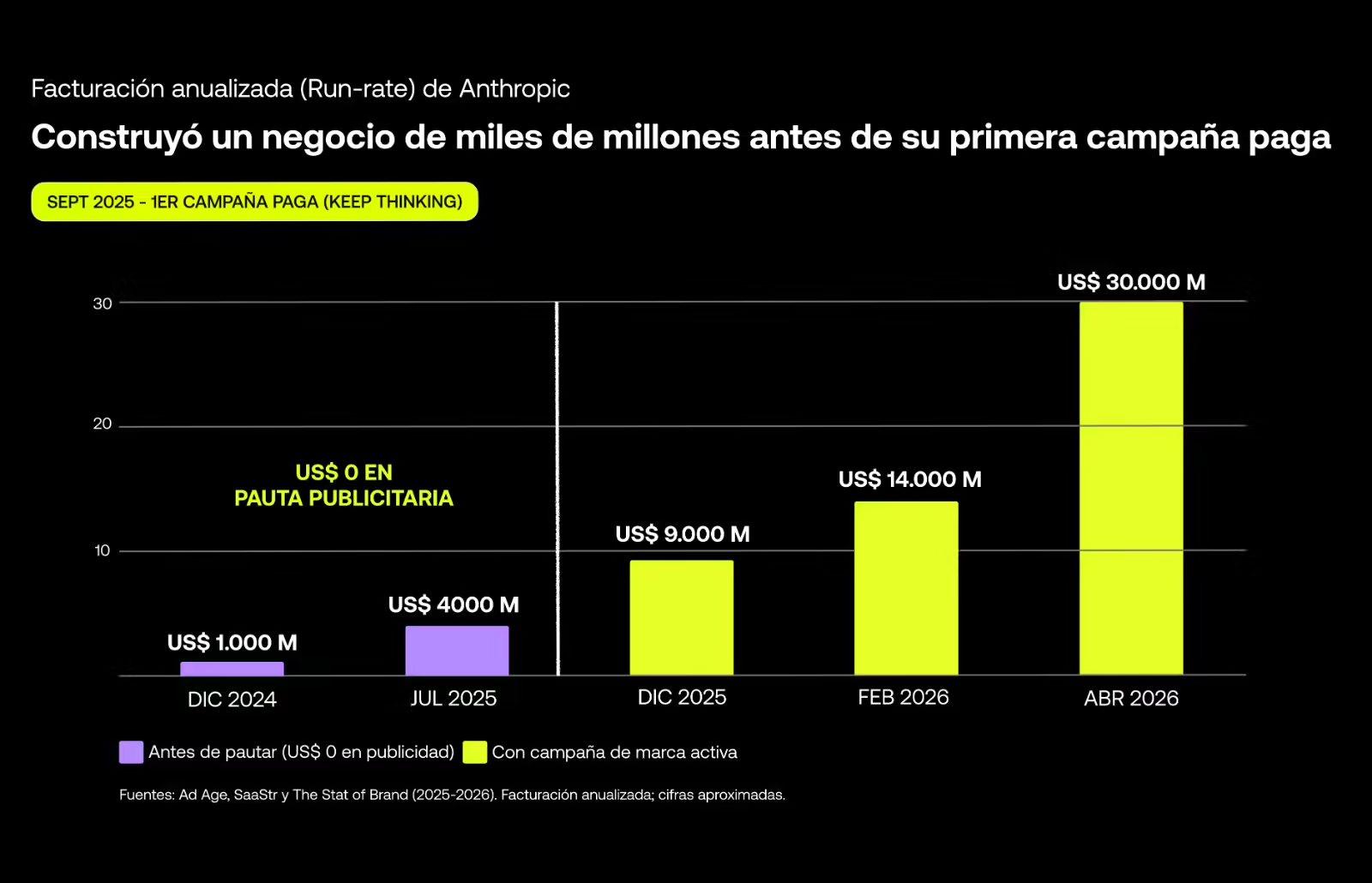
Its annualized revenue run-rate tells the story on its own:
Anthropic data.jpg
Sources: Ad Age, SaaStr and The State of Brand (2025–2026)
Put another way: the company grew from $1 billion to $9 billion in revenue with zero ad spend.
When it finally launched its first campaign, it wasn’t introducing its brand for the first time. It was putting a brand it had already spent four years building into the public eye, largely through research papers and model cards as communication channels and, according to Ad Age, with a marketing team that for much of that journey consisted of a single person, supported by AI.
The same pattern appears in the enterprise market, where Anthropic really plays.
According to Menlo Ventures’ State of Generative AI in the Enterprise report, Anthropic went from accounting for 12% of enterprise spending on LLM APIs in 2023 to 40% by the end of 2025, while OpenAI fell from 50% to 27%.
All of this supported an annualized revenue run-rate that reached $30 billion in April 2026, ahead of OpenAI’s roughly $25 billion, the first time a competitor had surpassed the category leader in reported revenue.
Again, without overselling it: Anthropic winning in enterprise doesn’t mean it has “won” the consumer market.
By user count, Claude is still much smaller: estimates put it at roughly 56 million users versus ChatGPT’s nearly one billion.
The campaign didn’t close that gap.
What made the difference wasn’t sheer scale, but monetization density: enterprise, API and Claude Code, where Anthropic holds 54% of the coding market compared with OpenAI’s 21%.
The campaign doesn’t explain that business on its own, but it supports it and makes the strategy visible.
Sometimes it’s better to ask permission
Our beloved marketing guru Seth Godin gave this idea a name: “permission marketing.”
Or, to borrow the spirit of an old saying: if you don’t push people away, they’ll come back on their own.
Permission is never granted once and forever. You earn it again every time someone comes back with another question.
Claude dramatizes this in the most literal possible way: it doesn’t speak unless you ask it something, and the answer belongs entirely to the person who asked.
The “automated human” in the commercial represents the other side of that same coin: the interruption marketing Godin defined permission marketing against.
Someone asks how to improve their relationship with their mother (one of the two Cannes-winning spots is literally called “How Can I Communicate Better With My Mom?”) and right in the middle of that conversation, an ad barges in without being invited.
Without meaning to, the competition itself proved this wasn’t just a clever creative idea.
Sam Altman, CEO of OpenAI, publicly pushed back against the campaign on X, calling it “deceptive” and “clearly dishonest.”
People don’t publicly rush to debunk a harmless joke.
They do it when something hits a nerve.
Alright, back to creating
This isn’t about asking product teams to sprinkle a bit of brand tone into an app.
It’s about recognizing that a product decision (showing the reasoning process, refusing to sell advertising inside the conversation) can already be the brand strategy in action.
Anthropic did things in the right order: first came the business decision, then came the campaign bold enough to say it out loud.
A brand doesn’t live only in its campaigns.
It lives in every second when the product has the opportunity to fulfill what the campaign promised, and either chooses to do so or doesn’t.
The awards confirm that something worked.
The “Keep Thinking” brand campaign by Mother won Best B2B Campaign at the 2026 Ad Age Creativity Awards, the year’s most awarded B2B campaign, from a company that barely advertises.
And the Super Bowl spots grouped under “A Time and a Place,” by Mother London, won the Film Grand Prix at Cannes Lions 2026, the festival’s oldest category.
Even so, we believe what really holds the case together isn’t the metal they won.
It’s the fact that the brand promise and the value proposition coexist without friction, and the ultimate winner is the user.
If you’ve made it this far, you might have a few questions
What’s the difference between a brand promise and a value proposition?
The brand promise is what the communication tells you you’re going to get, it lives in the campaign. The value proposition is what the product actually delivers, it lives in the experience.
They meet for the first time during the user’s first interaction, and that’s where the brand becomes either true or false.
What is the “wow moment” in UX?
It’s the moment when users experience the product’s value for the first time.
For it to happen, three layers need to align: verbal language (copy and tone), visual language (interface and micro-interactions) and the experience itself (the funnel and timing).
If one of those layers fails, the wow moment never arrives.
What’s the difference between storytelling and story-doing?
Storytelling is what the brand says. Story-doing is what the product does.
When they drift apart, a gap appears between promise and experience. When they work together, communication becomes believable because the product backs it up.
What is Seth Godin’s permission marketing?
It’s a strategy in which a brand earns the right to communicate with users instead of interrupting them.
It stands in opposition to interruption marketing, unsolicited advertising.
Claude takes this idea almost literally: it doesn’t speak unless you ask it something.